

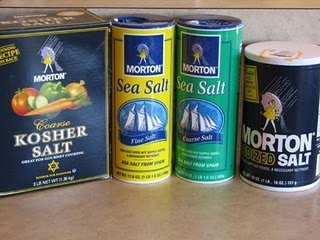
I decided that since some of my recipes, like the artisan bread in five minutes, call for different types of salt it would be a good time to talk about salt.
Many of my recipes use different types of salt. I use kosher or sea salts when I grill meats and vegetables. Sea salt is great sprinkled on raw vegetables. Many of the breads I make call for sea or kosher salt.
Does it make a difference what salt you use? Yes, it does. To an extent salt is salt, but like many things in cooking or baking, there is science behind which salt you need to use. They are all salt but they can not and should not be used interchangeably, especially in baking. It will affect the results of your recipes. They will taste too salty or not salty enough. If you want to use table salt in place of kosher salt, you need to use less.
I did some research online about the how and why of salt. There is a lot of information on the subject. I found a post on allrecipes that explained the different types of salt well. It also gave the measure for measure amounts that you should use when substituting.
I decided they explained it better than I could, so here is part of the article from allrecipes. To view the whole article go here.
Here is part of what they say:
What’s the Difference?
Although salt is salt–it is all sodium chloride–trace minerals found in sea salts and certain mined salts can change the color and flavor of salt. Refining takes away these individual characteristics. If you invest in an imported or high-quality salt, don’t use it in your pasta-cooking water: reserve it for finishing a dish.
Measure for Measure: Because of the size and shape of their crystals, sea salt, table salt and kosher salt should not be used interchangeably. Even different brands of kosher or sea salt may measure up differently. As a general rule: one teaspoon of regular table salt equals two teaspoons of Diamond Crystal brand kosher salt or 1-1/2 teaspoons of Morton brand kosher salt. Sea salts can generally be used interchangeably with table salt, unless they’re large flakes. In that case, “Salt to taste” is the best guide.
Table Salt: A standard condiment salt, refined into fine, uniform, dense grains with additives that keep the crystals from caking and help ensure a steady pour from salt shakers.
Iodized Salt: Table salt fortified with the mineral potassium iodide. Iodine deficiencies can lead to serious mental and physical impairment. In 1925, the U.S. government began fortifying salt with iodine, choosing salt because it is universally consumed.
Sea Salt: Salt that has been harvested from evaporated sea water. The large flakes are easy for cooks to pinch between their fingers, and the texture adds crunch and flavor when added at the table. Fleur de sel, “flower of salt,” is one of the best known sea salts, harvested in France and renowned for its delicate flakes and fine flavor.
Kosher Salt: A coarse salt that does not contain additives. Kosher salt is used in traditional Jewish preparations to make meats kosher by drawing out blood from the tissue. Many cooks find that it has a superior flavor, and its larger grains and coarse texture make it easy to cook with.
Seasoned Salt: Table salt flavored with ingredients like dried garlic or onions. Hawaii produces salts that are mixed with lava and clay particles to produce attractive pink and dark gray salts. Some specialty purveyors offer smoked salts for added flavor.
Rock Salt: Less refined than other salts, grayish rock salt is often used for freezing ice cream and melting sidewalks.
I hope you enjoyed learning about salt.
For more kitchen tips see Tammy’s Recipes.
Don’t forget about pickling salt! It’s finer (dissolves easier) and they don’t add iodine or anti-caking agents to it (which apparently can discolor the veggies you’re pickling).
My all time favorite salt is “Real Salt.” It’s mined in Utah and a lot milder than regular table salt =)
Thanks, I forgot about the pickling salt. There is a lot more to salt than most of us realize.
Great info! I have been starting to use other salts – sea salt and have used kosher salt in the past. Thank you for posting about the differences. 😀
Have a great day!
Sherry